

AI approach
Private AI that only drafts.
A named clinician reviews every suggestion, and every review is on the audit trail. Off by default. Synthetic data only; not clinically validated.
Philosophy
An assistant that proposes. A person who decides.
Off by default
AI is disabled per organisation until an administrator turns it on, and each propose-only assistant is switched on separately.
A server you control
It runs on a private OpenAI-compatible server. Identifiers are removed before anything is sent.
Draft only
Drafts and proposals only. Nothing can send, order, sign or submit.
Named review
A named clinician accepts, edits or rejects each clinical draft, bound to their own note revision.
How a draft is made
From note to audit trail.
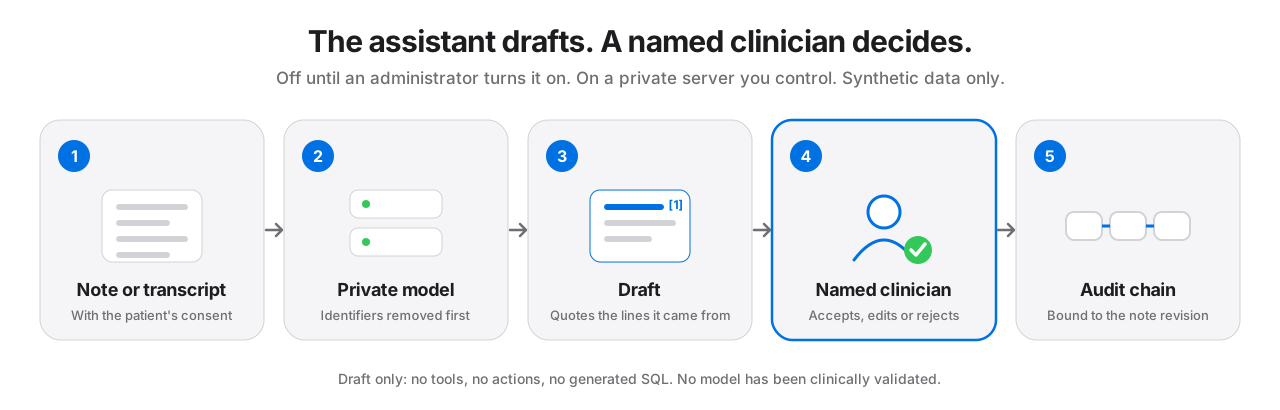
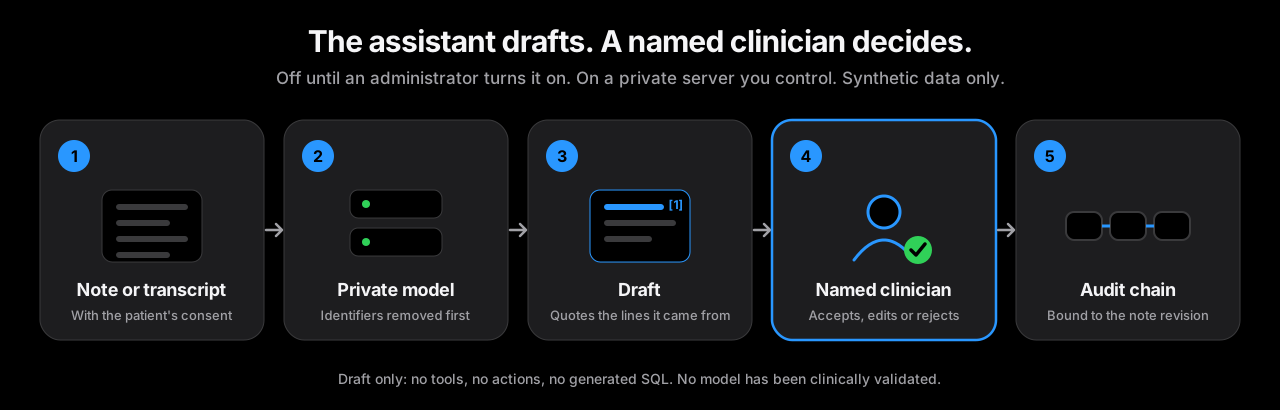
- Input. A note, or, with the patient's consent, a transcript.
- Private model. Identifiers are removed, then the request goes to the OpenAI-compatible server you run.
- Draft. Every statement points to the lines it came from.
- Review. A named clinician accepts, edits or rejects each one and signs.
- Audit. The review is bound to the note revision and recorded on the append-only, hash-chained audit trail, written in the same transaction as the change.
Current assistants
What exists today.
| Feature | What it does |
|---|---|
| Consultation assistant | With the patient's consent, a transcript becomes a draft whose every statement points to the lines it came from; a named clinician accepts, edits or rejects each one and signs. |
| Drafts | SOAP drafts, summaries, coding suggestions, document extraction, medicines read from a scan, conditions to consider (each must quote the note), an operations brief. |
| Propose-only assistants | Discharge, claims, handover and patient-reply assistants: read-only tools under the caller's permissions, every cited id checked, a person accepts a suggestion as a task or dismisses it; off until an administrator turns each on. |
| Review | Every clinical draft needs a named human review bound to the clinician's own note revision. |
What it never does
The model has no way to act.
No tools that act
Drafting assistants have no tools. The propose-only assistants can read only what the signed-in person may read, and none can send, order, sign or submit.
No generated SQL
Questions about the hospital run over a closed catalogue of eleven metrics.
No clinical decisions
It is not a clinical decision tool. Triage decision support in the emergency board is a trained classifier plus safety rules, not an LLM.
Back end
Bring your own private model.
Any OpenAI-compatible server you control. Nuvora, a self-hosted AI platform with an OpenAI-compatible API, is the preferred back end. Its wire contract has been checked only against Nuvora's offline demo provider, not a live model.
Honest limits
What we have not done.
- No model has been clinically validated and no accuracy figure is claimed. Review is mandatory.
- One live check against a small local model mis-filed an assessment under objective, which is why review is mandatory.
- Not certified against HIPAA, GDPR, ISO 27001, SOC 2, IEC 62304, NABH/JCI or similar.
- Languages other than English and ABDM are not built yet.
- The demo’s assistant is a stand-in; all screens and figures use synthetic data.
Want to see it?
Try the demo with invented patients, or ask us about a private AI pilot.